You check your bank app on a Wednesday night and realize you have $42 left for the next nine days. You remember buying groceries, gas, a few lunches out, and a pair of sneakers, but none of it felt reckless. That is the moment a lot of people start looking for a different way to budget.
The cash envelope method is old, simple, and a little inconvenient. That inconvenience is exactly why it still helps. You do not need to give up your cards or delete your apps. You just need a system that makes your spending feel real again.
What the Cash Envelope Method Actually Is
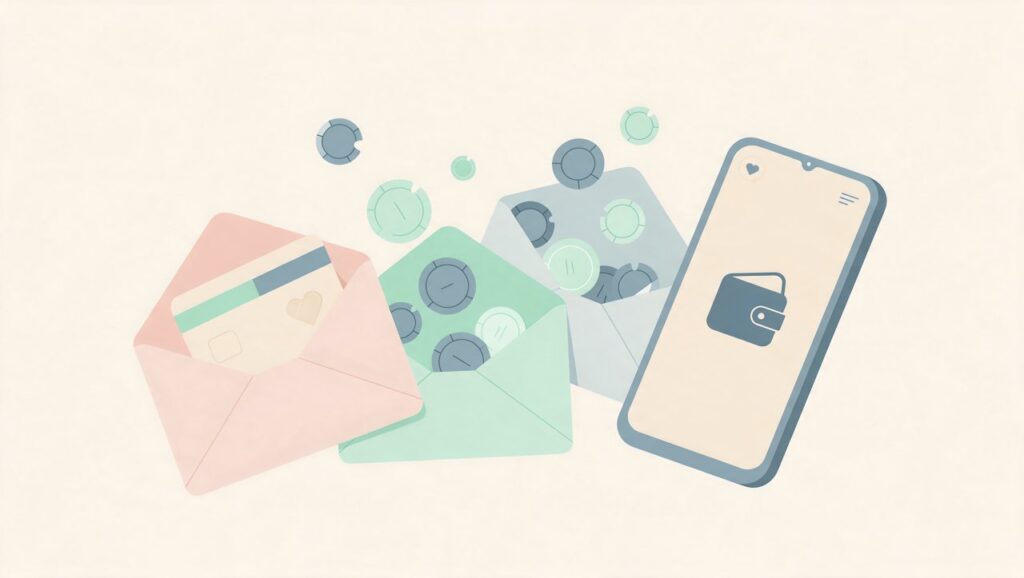
The cash envelope method is a before-you-spend budget. You decide what you can spend in a few categories for the week or month, take that amount in cash, and put it in labeled envelopes. Groceries, gas, dining out, fun money, clothing. When an envelope is empty, you stop spending in that category until the next refill. You can move money from one envelope to another, but you have to see it happen. That is the point. The method has been around for decades because a number on a screen is easy to ignore, but an empty envelope is not.
Say you budget $500 for groceries and $100 for dining out. After a big weekend, the dining envelope has $9 left. You can still go out, but you are ordering a sandwich, not a steak. The envelope does not judge you. It just tells you what is left.
This is different from tracking after the fact. Most people check their bank app after the damage is done. The envelope method forces a decision before you spend. You look at the cash, not the category balance on a screen. For some people, that physical limit changes everything.
Why Cash Hurts in a Good Way
Paying with a card or phone is smooth. You tap, you leave, and the receipt shows up later. Cash is not smooth. You have to open the envelope, pull out bills, count them, and hand them over. That small pause gives your brain a chance to ask a simple question: do I actually want this?
There is a reason many people report spending less with cash, and researchers have studied the idea that paying with cash feels more painful than paying with a card. When you pay with cash, the loss is immediate and visible. When you pay with a card, the loss is delayed and abstract. A $60 grocery run feels different when you hand over three twenties than when you swipe a piece of plastic.
This matters most for wants, not needs. You probably will not overspend on rent because you are not making an emotional decision. But a coffee, a new shirt, or a quick lunch out is different. Cash puts just enough friction in the way to slow you down.
You can test this without changing your whole budget. Take $40 in cash for one weekend of small purchases. Use only that cash. Notice how many times you pause before spending. That pause is the method working.
Where Cash Envelopes Still Win
Cash envelopes work best in categories where you have choices every week. Groceries, dining out, entertainment, personal spending, and clothing are common starting points. These are flexible categories. You can spend a little or a lot depending on your mood. Cash gives you a hard stop.
They also work well if you are new to budgeting. When you are not used to tracking every dollar, a card makes it easy to drift. Cash is harder to ignore. You can see the envelope getting thin.
Couples can benefit too. If you and your partner share a grocery envelope, you both know what is left without a spreadsheet or a text argument. The envelope becomes a shared agreement. When it is empty, the conversation is simple: we wait or we move money from somewhere else.
Cash is also useful at places where small spending adds up. Farmers markets, food trucks, vending machines, tips, school fundraisers. If you carry a limited amount, you cannot blow past your limit.
Start with two or three categories. You do not need an envelope for rent, utilities, or insurance. Those are fixed and usually paid online.
Where Cash Envelopes Fall Apart
Cash does not work for everything. Rent, mortgage, utilities, phone bills, subscriptions, and insurance are digital by nature. You cannot mail cash for every bill, and you should not try. Those categories belong in a checking account with automatic payments or scheduled transfers.
Cash also has real risks. If you lose an envelope or it gets stolen, that money is gone. A debit or credit card can be frozen and disputed. Cash has no fraud protection. Carrying hundreds of dollars for groceries and gas may not be practical or safe.
Another problem is record keeping. With a card, your bank app shows exactly where money went. With cash, you have to keep receipts or write things down. If you are not willing to do that, cash envelopes can become a mystery.
Cash also does not earn interest. Money sitting in envelopes is idle. Money in a high-yield savings account or money market account may earn something. Check your bank or credit union for current rates and compare. The difference may be small for short-term spending money, but it is worth knowing.
Finally, cash is inconvenient for online shopping. You can use a card and then remove cash from the envelope, but that adds a step. If most of your spending is online, a digital envelope system may fit better.
The Digital Envelope Alternative
The core idea of an envelope is not the paper. It is the limit. You can create the same limit with digital tools and keep the convenience of a card or phone. The key is to separate money into categories before you spend, then check the category balance before you buy.
There are three common ways to do this.
Bank sub-accounts or buckets
Some banks and credit unions let you open multiple savings accounts or create labeled buckets inside one account. You can name one Groceries, one Car, one Fun. After each paycheck, transfer your budgeted amount into each bucket. When you spend, move money from that bucket to your checking account or log the purchase.
Budgeting apps
Apps like YNAB and Goodbudget are built around the envelope idea. You assign dollars to categories before you spend. When you enter a transaction, the category balance drops. You check the app before you spend, not after.
Spreadsheet
Google Sheets or Excel works if you want a free manual option. Create a column for each category, a starting balance, a spent column, and a remaining column. Update it every few days. This takes more effort but gives you full control.
The best choice is the one you will actually check. If you live in your bank app, use sub-accounts. If you want a phone app with reminders, try a budgeting app. If you like simple and private, use a spreadsheet.
Setting Up Digital Envelopes With Your Bank
Start by checking what your bank or credit union offers. Log into the app or website and look for savings accounts, sub-accounts, or bucket features. If you are not sure, call or send a secure message. Ask whether you can open more than one savings account and whether there are fees or minimum balance rules.
Once you know the rules, set up a few categories. Good starter categories are Groceries, Gas, Dining Out, and Fun. You do not need a separate account for every line in your budget. Fixed bills can stay in checking.
After each paycheck, transfer the planned amount into each category account. For example, if you get paid twice a month and budget $600 for groceries, transfer $300 each payday. Then use your debit or credit card normally. When you buy groceries, move the same amount from the Groceries account to checking, or just pay from that account if it has a debit card.
Watch out for fees. Some accounts charge a monthly maintenance fee if your balance is below a certain amount. Some limit how many transfers you can make each month. Check the current fee schedule before you open anything. A free checking account plus a simple spreadsheet may be better than paying fees for multiple accounts.
The goal is to make the category balance visible. If your Groceries bucket has $42 left, that is your grocery budget until next payday. No envelope required.
Using Budgeting Apps as Envelopes
Budgeting apps take the same idea and put it on your phone. You set up categories, assign money to them, and record spending as it happens. The app shows what is left in each category. Some apps can import transactions from your bank, but you still need to approve the category. Others are manual.
YNAB is a popular envelope-style budgeting app. You give every dollar a job before you spend it. When you overspend in one category, the app asks you to cover it from another category. That is the digital version of moving cash between envelopes. Goodbudget uses virtual envelopes and works well for people who want a simple visual layout. Google Sheets is not an app, but it can do the same job if you prefer a free and private option.
Here is a simple weekly routine for any app or spreadsheet:
- Enter transactions at the moment you spend, or set a daily reminder.
- Before a purchase, glance at the category balance.
- If the balance is low, decide to wait or move money from another category.
- On payday, refill the categories with your new income.
The app will not stop your card from working. The limit is still your own attention. But the app makes the limit easier to see than a paper envelope in a drawer.
Pick one app and use it for a month before switching. The habit matters more than the features.
The Hybrid Approach: Cash for Trouble Categories
You do not have to choose between cash and digital. Many people get the best results with a hybrid system. Keep fixed bills and online spending in your bank accounts. Use cash for two or three categories where you tend to overspend.
Start by looking at the last two months. Which categories did you blow past? For a lot of people, it is groceries, dining out, or impulse spending. Pick two. Take those amounts in cash after each paycheck and put them in envelopes. Leave everything else in the bank.
This keeps your cash carry small. You are not walking around with your whole paycheck. You are carrying only what you need for the week or month. If you lose one envelope, the damage is limited.
For online purchases in a cash category, use a simple rule. If you order groceries for pickup or delivery, pay with your card, then take the same amount of cash out of the envelope and put it in a jar or back into your checking account. That keeps the envelope honest.
Couples can use a hybrid system too. Keep a shared cash envelope for groceries and personal fun money. Pay joint bills from a shared checking account. Each person can have a small personal cash envelope with no questions asked.
The hybrid method works because it adds friction only where you need it. You keep the convenience of digital for fixed costs and the pain of cash for the categories that get away from you.
Common Mistakes and How to Avoid Them
Most cash envelope failures come from a few predictable mistakes. Here is what to watch for.
- Too many envelopes. Start with four to six categories. If you have twenty envelopes, you will spend more time sorting cash than budgeting.
- Unrealistic amounts. If you set your grocery budget at $200 when you normally spend $600, you will quit by week two. Use your past spending as a starting point, then reduce slowly.
- Borrowing too often. Moving money between envelopes is allowed, but if you do it every week, your budget is not realistic. Adjust the amounts instead of blaming the method.
- Forgetting irregular expenses. Car repairs, gifts, annual fees, and school costs show up eventually. Create a sinking fund category for them, either in cash or in a separate savings account.
- Carrying all your cash. Take only the envelope you need for that errand. Leave the rest at home in a safe place.
- Treating cash as free money. An envelope with money in it is not permission to spend. It is a limit. Ask yourself if the purchase matches your priorities.
- Quitting after a bad week. One overspent week is information, not failure. Adjust and keep going.
If you avoid these mistakes, the system becomes easier over time. The first month is the hardest.
Start This Week: A Quick Checklist
You do not need a perfect plan to start. Use this checklist to set up a simple envelope system this week.
- List your variable spending categories for the last month. Groceries, gas, dining out, entertainment, shopping, personal care.
- Pick two or three categories for your first envelopes. Choose the ones where you overspend most.
- Set a weekly or biweekly amount for each category based on your last month of spending.
- Decide on cash or digital. If cash, withdraw the amount after your next paycheck. If digital, open sub-accounts or set up categories in an app.
- Label the envelopes or accounts clearly. Cash envelopes should be labeled with the category and amount.
- Put receipts in the envelope or enter digital transactions the same day.
- Schedule 15 minutes on the same day each week to review what is left.
- If a category runs out, stop spending or move money from another category and write it down.
- At the end of the month, compare your budgeted amounts to what you actually spent. Adjust for next month.
- Keep fixed bills in your checking account and automate them if you can.
Start small. The cash envelope method works when you actually use it, not when you build the perfect system on paper. This article is general education, not personalized financial advice.